Building Production-Ready Agents with watsonx Orchestrate: A Pro-Code/Low-Code Architectural Guide

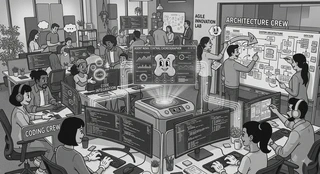 Photo by Nano Banana on Gemini
Building Production-Ready Agents with IBM watsonx Orchestrate: A Pro-Code/Low-Code Architectural Guide
My journey with watsonx Orchestrate began at the Agentic AI Academy in Paris in March 2025 —a pivotal event that shaped my understanding of the product’s development direction. Since then, I tested it in demos and in sandbox projects. I decided to write up this series of blog to document (for myself) my journey and understanding of the framework. I want to start with a first clear lesson: the true power of this platform comes from knowing when to leverage code and when to embrace the low-code interface.
It’s not an “either/or” decision—it’s a calculated architectural synthesis that, when done right, delivers both the flexibility of custom development and the speed of visual assembly.
The Architectural Synthesis: Pro-Code Agility Meets Low-Code Speed
As an AI engineer, I’ve learned that the most effective watsonx Orchestrate implementations blend two distinct approaches. Here’s how to think about each and when to use them.
1. The Pro-Code Anchor: The Agent Development Kit (ADK)
When you encounter complex, stateful, or computationally intensive tasks—the core business logic—you must reach for the Agent Development Kit (ADK). This is your Pro-Code First zone.
Why? Because calculating something like prorated vacation days based on custom seniority rules requires the flexibility and computational power of a Python tool. Simple, low-code API connectors (like MCP) are excellent for making a standard REST call, but they fall short when you need deep, custom programmatic logic and complex data manipulation. The ADK ensures your high-value agents are built on a solid foundation of reliable code.
2. The Low-Code Accelerator: The Agent Builder
Once your custom logic is secured in a Python tool via the ADK, you pivot to the Agent Builder for orchestration and speed. This is the Low-Code/Quick Setup environment.
The Builder excels at two things: assembly and observability. It’s the fastest way to integrate knowledge bases, assemble a workflow from various skills, and, crucially, to monitor your agents. Features like Knowledge analytics and trace details provide a vital “glass cockpit” for RAG performance, allowing you to debug and refine your agent’s knowledge retrieval without diving back into custom code. It acts as the high-speed glue and the maintenance dashboard.
3. Modularity is Precision: Process Decomposition
The most critical architectural decision for scalability is Process Decomposition, and it’s all about managing the Large Language Model’s (LLM’s) cognitive load.
A single, monolithic agent attempting to handle an entire complex workflow (e.g., “submit days off”) may succumb to tool-routing failure. The LLM gets overwhelmed trying to decide between five different tools at any given step.
The solution is the Supervisor/Manager agent topology. We break that complex workflow into smaller, single-purpose, modular agents (“Check Balance,” “Submit Request,” “Confirm Leave”). The main Manager agent now only has one job: delegate to the correct, highly specialized sub-agent. This approach drastically simplifies the LLM’s reasoning and tool-routing decision, leading to a measurable boost in overall execution accuracy and scalability.
4. The LLM’s Instruction Manual: Routing Clarity
Finally, all this architectural precision hinges on one seemingly simple detail: Agent descriptions.
The LLM doesn’t “read your code”; it reads the description of your tool or agent to decide if it’s the right fit for the user’s intent. Therefore, this description must serve as a crystal-clear contract: non-technical, precise about the agent’s purpose, and explicit about its required inputs and expected outputs. Ambiguity here is poison. If the documentation is vague, the LLM’s planning function falters, resulting in unreliable autonomous execution—the agent picks the wrong tool, and the user gets a bad experience. Clarity in documentation is paramount to operational reliability.
Key Takeaways
Building production-ready agents with watsonx Orchestrate requires a deliberate architectural approach:
- Embrace the hybrid model: Use the ADK for complex, custom logic and the Agent Builder for orchestration and monitoring.
- Decompose for scale: Break monolithic workflows into specialized, modular agents to reduce cognitive load on the LLM.
- Write for the model: Treat agent descriptions as contracts—clear, precise, and unambiguous.
The difference between a working agent and a reliable agent often comes down to these architectural choices. My goal is to master them to build agents that scale.
This is the first of four blogs I wrote to crystallize my understanding of a framework—watsonx Orchestrate—that I use daily. There are many other frameworks for building agents, and IBM watsonx Orchestrate shares some commonalities with them, including Python-based tooling, MCP integrations, and agentic design, among others. Still, each framework has its own peculiarities. If you find this useful, I hope you’ll continue reading the rest of the series.
