Hybrid Platform: A Panel at IBM TechXchange 2025

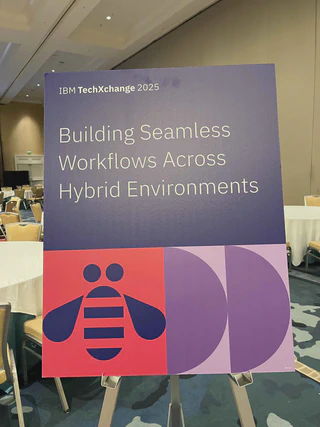 Image credit: Welcome Board
Hilton Orange D, Lower Level Orlando
From Silos to Seamless Flow – Building Hybrid Workflows That Scale
A Personal Note
I was honored to moderate the IBM TechXchange 2025 Peer Roundtable titled “Building Seamless Workflows Across Hybrid Environments.” As an AI consultant and IBM champion I had the pleasure of moderating the conversation, fielding questions, and helping the participants surface practical patterns for integrating on‑prem, cloud, and edge resources into a single, reliable workflow.
My partners in crime were Chris Backer, Madhu Kochar, Steven Perva, and Sarah Julia Kriesch.
Below you’ll find a concise recap of the roundtable insights, followed by a deeper dive into the lessons learned and actionable tactics you can start using today.
📊 Quick‑Take Summary of the Roundtable
| What We Explored | Why It Matters | Key Take‑aways for Practitioners |
|---|---|---|
| Connecting disparate tools & platforms (on‑prem, cloud, edge) | Breaks silos, reduces manual hand‑offs, unlocks automation. | • Create a single source of truth inventory of services. • Adopt API‑first integration layers. • Use event‑driven patterns (Kafka, IBM Event Streams) for real‑time data flow. |
| Common setbacks (inconsistent APIs, latency spikes, vendor lock‑in) | Project delays, higher TCO, unpredictable performance. | • Implement contract testing early. • Apply observability stacks (Prometheus, IBM Observability by Instana). • Prefer containerized, stateless services to mitigate lock‑in. |
| Security & visibility across hybrid landscapes | A breach in one domain can cascade; lack of visibility stalls troubleshooting. | • Deploy Zero‑Trust networking and micro‑segmentation. • Centralize IAM. • Unified logging/SIEM (IBM QRadar) for cross‑environment correlation. |
| Regulatory & governance pressures | Uncertainty can freeze innovation; clear guidance can accelerate road‑maps. | • Adopt policy‑as‑code. • Map regulations to concrete data‑flow controls and automation rules. • Leverage AI‑driven compliance dashboards for proactive risk detection. |
| AI‑enhanced workflows (e.g.,with Maximo and IBM watsonx) | Turn data into actionable insight, speed decision‑making, cut manual effort. | • Use a data‑fabric platform to feed trusted AI models. • Start with low‑risk use cases—predictive maintenance, anomaly detection—and expand as confidence grows. |
1️⃣ Why Hybrid Integration Is No Longer Optional
Modern enterprises run on a patchwork of on‑premises servers, public clouds, and edge devices. When each environment speaks its own language, moving data becomes costly and error‑prone. The roundtable showed that the first step toward a unified workflow is visibility: catalogue every endpoint, map its data contracts, and treat every interaction as a first‑class API.
Takeaway: A single source of truth for services and contracts eliminates unexpected breakages downstream.
2️⃣ Common Pitfalls & How to Dodge Them
| Pitfall | Real‑world Symptom | Remedy (from the discussion) |
|---|---|---|
| Inconsistent API contracts | “The integration failed because the vendor changed the schema overnight.” | Adopt contract testing and versioned API gateways. |
| Latency spikes in cross‑cloud calls | “Requests take >5 s when hitting an external SaaS.” | Move to event‑driven architectures and place compute closer to the data source (edge). |
| Security blind spots | “We discovered a compromised edge node weeks later.” | Implement Zero‑Trust policies and unify logging with SIEM. |
| Regulatory uncertainty | “New data‑localization rules forced us to halt a migration.” | Use policy‑as‑code and AI‑enabled compliance dashboards to pre‑emptively adapt. |
3️⃣ The Role of AI in Making Workflows “Smart”
AI isn’t a silver bullet, but it turns data into insight that can automate decisions. Participants highlighted three practical entry points, one of which directly ties to the public administration and from the application of Maximo to predictive maintenance:
- Predictive Maintenance – Using sensor streams from edge devices to trigger pre‑emptive service calls.
- Anomaly Detection – Feeding unified logs into a machine learning model that flags out‑of‑pattern behavior before it becomes an outage.
- Workflow Optimisation – Recommending the next best step in an automation chain (e.g., “run job X before job Y”) based on historical success rates.
4️⃣ Governance + Speed: Managing Regulatory Constraints
Regulators often feel like moving finish lines. The conversation on the regulatory hurdles kept was vivid. The roundtable consensus was:
- Policy‑as‑Code turns abstract rules into executable checks that run automatically in CI/CD pipelines.
- Unified Governance Platforms (for example, watsonx Governance for AI models) provide a single pane of glass for data‑location, retention, and access policies.
- AI‑assisted compliance can surface the most urgent gaps, allowing teams to pause or accelerate projects with data‑backed justification rather than guesswork.
5️⃣ Blueprint for a “Seamless Workflow” Initiative
- Discover & Map – Catalogue every system, data source, and integration point.
- Standardize Contracts – Define OpenAPI specs, versioning rules, and test contracts.
- Build Observability – Deploy metrics, tracing, and logs that span environments.
- Secure the Path – Apply micro‑segmentation, IAM federation, and data‑masking where needed.
- Layer AI Incrementally – Choose a pilot use case (e.g., the email‑reply automation), train models on trusted data, and monitor ROI.
- Govern & Iterate – Use policy‑as‑code to keep compliance baked into every release.
6️⃣ Closing Thought
The roundtable proved that speed and safety are not opposites—they become allies when you design integration with visibility, automation, and governance baked in from day one. By treating hybrid environments as a single, programmable fabric, organizations can unlock the agility needed to compete in today’s data‑driven market.
